How Atelico compares
Different tools serve different use cases. Here's how Atelico compares for game and application developers.
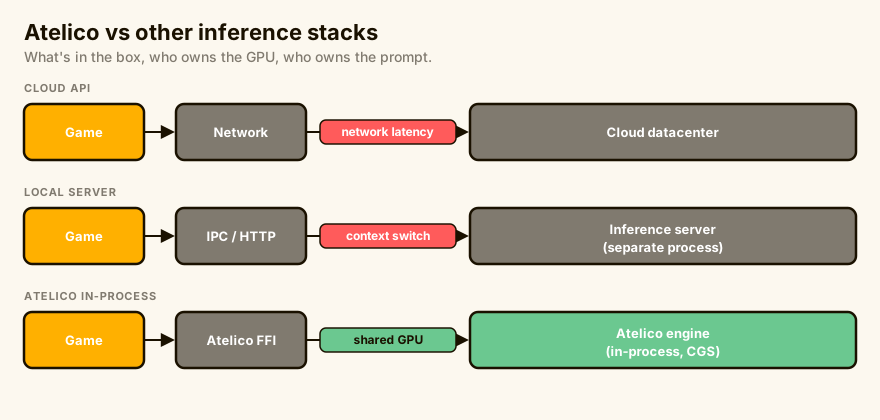
vs. Game AI Platforms
| Capability | Atelico | NVIDIA ACE | Artificial Agency | Qualcomm Game AI |
|---|---|---|---|---|
| On-device inference | ✓ Metal, CUDA, CPU | ✓ RTX GPUs (NVIGI) | Cloud (on-device unproven) | ✓ Hexagon NPU |
| GPU sharing with renderer | ✓ CGS (NVIDIA + Metal) | ✓ NVIGI (CiG) | N/A | N/A (NPU, separate from GPU) |
| Platforms | macOS, Windows, Linux, iOS, Android (soon) | Windows (NVIDIA RTX only) | Cloud | Snapdragon Android + X Elite laptops |
| Game engines | ✓ Godot, Unity, UE5, C ABI | UE5 (deep integration) | UE, Unity, C ABI | UE 5.6+ (3 plugins) |
| LLM inference | ✓ Llama, Qwen, Gemma, SmolLM, Nemotron, Bonsai 1-bit | ✓ Nemotron, Llama, Mistral-Minitron, Qwen3 | Unknown | ✓ Via GenIE SDK (NPU) |
| Structured generation | ✓ JSON Schema, choice, regex, Lark grammar (token-level) | ✓ JSON Schema, choice, regex, Lark grammar (token-level) | No | No |
| Text-to-speech | ✓ Kokoro (54 voices, 9 langs) + Atelico TTS (instant voice cloning, 18× realtime) | ✓ Riva TTS | Undisclosed | ✓ Voice AI SDK (NPU) |
| Speech-to-text | ✓ Whisper | ✓ Riva ASR, Whisper | Undisclosed | ✓ Voice AI SDK (NPU) |
| Image generation | ✓ Atelico IG (~1s on M1 Max) | No | No | No |
| Lip-sync / facial animation | ✓ Audio2Face (60 fps, ARKit-52 blendshapes, runs on Metal & CUDA) | ✓ Audio2Face-3D (CUDA only) | No | No |
| Agent character behavior system | ✓ Dialogue, planning, reasoning, decision-making, memory, emotion | ACE Agent (RAG workflows) | ✓ Core product | No |
| Embeddings / vector search | ✓ Text, image, and audio embedding models, with vector search | E5-Large (via RAG) | No | No |
| Multimodal retrieval (search images and audio by text) | ✓ CLIP, SigLIP, CLAP, ImageBind, EBind | No | No | No |
| Content safety / guardrails | ✓ Keyword + ML + LLM judges | Ethical AI tools | Undisclosed | No |
| Visual perception | ✓ DINOv2 | ✓ Nemovision-4B | No | No |
| Audio perception | Coming soon | ✓ NeMoAudio-4B | No | No |
| LoRA hot-swap | ✓ | No | No | No |
| 1-bit quantization | ✓ Bonsai (8B in ~1.15 GB) | No | No | No |
| Open model support | ✓ Llama, Qwen, Gemma, SmolLM, Nemotron, Bonsai, any GGUF model | Mostly NVIDIA models + GGML | Undisclosed | 175+ via AI Hub (Snapdragon-optimized) |
| OpenAI-compatible API | ✓ | Partial (NIM) | No | No |
| iOS support | ✓ | No | No | No |
Atelico vs. NVIDIA ACE
ACE is a full-stack character AI suite covering speech recognition, reasoning, text-to-speech, and real-time lip-sync via Audio2Face-3D, with deep Unreal Engine integration. NVIGI handles on-device inference on RTX GPUs using hardware GPU sharing, similar to our approach. ACE also includes multi-modal perception models (NeMoAudio for audio, Nemovision for vision) that let NPCs "see" and "hear" their environment.
Where we differ: ACE is locked to NVIDIA RTX hardware and Windows. Atelico runs on macOS, Windows, Linux, and iOS with both Metal and CUDA support. We offer capabilities ACE lacks, including image generation, structured generation (JSON Schema, choice, regex, Lark grammar), LoRA hot-swap, and 1-bit quantization, while supporting Godot and Unity alongside Unreal. We also ship Audio2Face (60 fps ARKit-52 blendshapes ready for any rig, including MetaHumans) on Metal and CPU in addition to CUDA, so it works on Apple Silicon and on Macs and iPhones, not just NVIDIA GPUs. ACE requires NVIDIA AI Enterprise licensing ($1,000+/GPU/year) for cloud services; Atelico has no cloud dependency.
Atelico vs. Artificial Agency
Artificial Agency is building a character behavior system where game designers define NPC motivations, rules, and goals, and the AI generates autonomous actions, a "stage manager" pattern.
Where we differ: Artificial Agency demos run in the cloud. Atelico provides a Character Behavior System, covering dialogue, planning, reasoning, decision-making, memory, and emotion, and runs entirely on-device with no cloud dependency. We also provide a complete AI stack (LLM inference, TTS, STT, image generation, embeddings, guardrails), while Artificial Agency focuses mostly on behavior reasoning.
Atelico vs. Qualcomm Game AI SDK
Launched at GDC 2026, Qualcomm's SDK provides three Unreal Engine 5.6+ plugins for ASR, LLM inference, and TTS, all accelerated on the Hexagon NPU. Their approach separates AI inference from GPU rendering entirely, avoiding GPU sharing complexity. Backed by 175+ pre-optimized models via Qualcomm AI Hub.
Where we differ: Qualcomm is locked to Snapdragon hardware (Android phones and X Elite laptops). No macOS, no iOS, no discrete GPU support. The SDK is very new (March 2026) with limited documentation. Atelico supports larger models (8B+ with 1-bit quantization vs their ~2B limit), offers image generation, embeddings, character behavior system, and guardrails, none of which Qualcomm provides.
vs. Inference Tools
Atelico is built for the single-user, real-time regime games run in. On a standardized pure-decode benchmark, here is how it stacks up.
Full per-model, per-backend comparison on the benchmarks page →
| Feature | Atelico | Ollama | llama.cpp | MLX | vLLM |
|---|---|---|---|---|---|
| Game engine integration | ✓ Godot, Unity, UE5 | No | No | No | No |
| GPU sharing with renderer | ✓ | No | No | No | No |
| Authored content retrieval | ✓ | No | No | No | No |
| Fast image generation | ✓ ~1s | No | No | No | No |
| TTS / STT | ✓ Kokoro + Atelico TTS + Whisper | No | No | No | No |
| Audio → face animation | ✓ Audio2Face (60 fps, ARKit-52) | No | No | No | No |
| Character Behavior System | ✓ | No | No | No | No |
| Guardrails / safety | ✓ customizable cascade | No | No | No | No |
| Embeddings + vector search | ✓ | No | No | No | No |
| Multimodal retrieval (text, image, audio) | ✓ | No | No | No | No |
| OpenAI API compatible | ✓ | ✓ | ✓ | No | ✓ |
| macOS Metal | ✓ | ✓ | ✓ | ✓ | No |
| CUDA | ✓ | ✓ | ✓ | No | ✓ |
| iOS | ✓ | No | No | ✓ | No |
| GGUF support | ✓ | ✓ | ✓ | No | No |
| 1-bit quantization | ✓ | No | No | No | No |
| Structured generation | ✓ JSON Schema, choice, regex, Lark grammar | No | ✓ GBNF | No | ✓ |
| Embeddable (in-process) | ✓ | No | ✓ | ✓ | No |
| Language | Rust | Go | C++ | C++ | Python |
Atelico vs. Ollama
Ollama is excellent for running LLMs from the command line. But it's a standalone server process. It can't share GPU with your game renderer, and it has no game engine integration, content safety, or image generation.
Atelico vs. llama.cpp
llama.cpp is the gold standard for GGUF inference. Atelico uses GGUF too, but adds game engine integration, GPU sharing, image generation, semantic search, and guardrails in one package.
Atelico vs. MLX
MLX is Apple-only and Python-first. Atelico runs on Metal, CUDA, and CPU, and is designed for embedding in game engines, not Python scripts.
Atelico vs. vLLM
vLLM is CUDA-only and designed for high-throughput batched server deployments. The single-user real-time regime games run in is vLLM's weakest mode by design. Atelico is built for exactly that regime: one player, one request at a time, on-device, where frame-time matters more than throughput.