Atelico AI Engine
On-device AI engine for games
On-device AI that runs everywhere. LLMs, image generation, text-to-speech, speech-to-text, facial animation, semantic search, and a full NPC character behavior system. All running locally, all under your creative control. Native Godot, Unity, and Unreal integration. No cloud. No server costs.
Built by AI and gaming industry veterans from Uber, Meta, SEGA, Creative Assembly, Stanford, and MIT.
Creative Control
Your authored content, your rules. Semantic retrieval, state machines, structured generation, guardrails. The AI does what you tell it. The opposite of "hope the LLM says something good."
Learn more →Runs in Your Game
GPU sharing with your renderer. Native Godot/Unity/Unreal. In-process, not sidecar. The engine shares your GPU through hardware scheduling. Zero frame drops.
Learn more →Runs on Device
No cloud, no server costs. Ships with your game. Metal, CUDA, iOS, CPU. Models as small as 250MB.
Learn more →Start in minutes
See your engine's language first.
# Godot 4 -- Talk to an NPC
var engine = AtelicoEngineNode.new()
var response = await engine.chat(
    "What should I do next?",
    "You are a helpful NPC."
)AI that stays on script.
Author your content. Index it semantically. Let the AI find the right line at the right time, with guardrails that ensure it never goes off the rails.
Semantic KV Store
Authored dialogue, surfaced by context
Author hundreds of dialogue lines with metadata. The engine finds the right one based on context. Not generative slop. Your writers' words, surfaced at the right moment.
State-Driven Dialogue
Emotional arcs, not random tangents
Gate dialogue behind emotional states. Characters progress through your authored story beats: calm → nervous → defensive → cornered. Build branching narratives without branching code.
Guardrails Cascade
Layered safety, fully customizable
Keyword blocklists, ML classifiers, LLM judges, content rewriters. Start with a preset (ChildSafe, GameSafe). Then make it yours. Don't just block , rewrite.
Hear, speak, and lip-sync.
Voice in, voice out, and a face that moves with it. All on device, all running in real time on the same hardware as the rest of the engine.
1s of speech (Atelico TTS, M1 Max)
1s transcribed (Whisper tiny.en, M1 Max)
per facial-animation frame (Audio2Face, M1 Max)
Two TTS engines: Kokoro for high-quality narrative lines (54 voices, 9 languages) and Atelico TTS for high-throughput ambient barks with instant voice cloning.
Whisper STT for player voice input. Audio2Face emits ARKit-52 blendshape weights at 60 fps to drive any rig, including MetaHumans.
Generate images in ~1 second.
The proprietary Atelico IG model, purpose-built for on-device inference, generates high-quality images dramatically faster than anything else running locally.
M1 Max (Metal)
iPhone 13
RTX 5080 (CUDA)
Generate textures, item icons, character portraits, loading screens, at runtime, on the player's device. No cloud API costs.
Adapter support for fine-tuning to your game's visual style.
Native game engine integration.
In-process, not sidecar. The engine shares your GPU with your renderer using the best hardware-level scheduling mechanism available on the platform. Zero frame drops.

Godot 4
Native GDExtension. Call from GDScript. Ships as an addon.

Unity
C# P/Invoke bindings. Drop-in integration. Async support.

Unreal Engine 5
UE5 subsystem integration. FFI bindings. Blueprint compatible.
Faster, lighter, frame-perfect.
Frame-time impact first, then everything else. Every number below is measured on consumer hardware (M1 Max, RTX 3090, RTX 5080), not on a datacenter GPU.
GPU sharing without frame drops
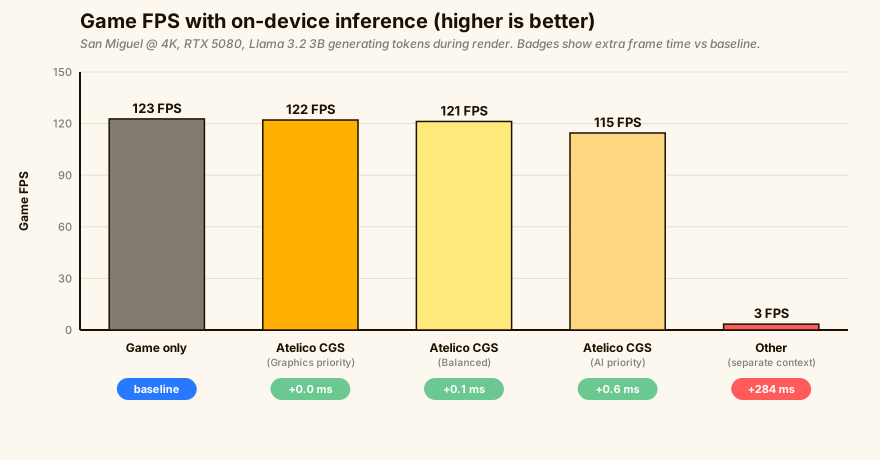
Full per-mode breakdown and the lighter Sponza scene live on /ai-engine/gpu-sharing.
Decode speed vs llama.cpp
On every measured model, across CUDA and Apple Silicon.
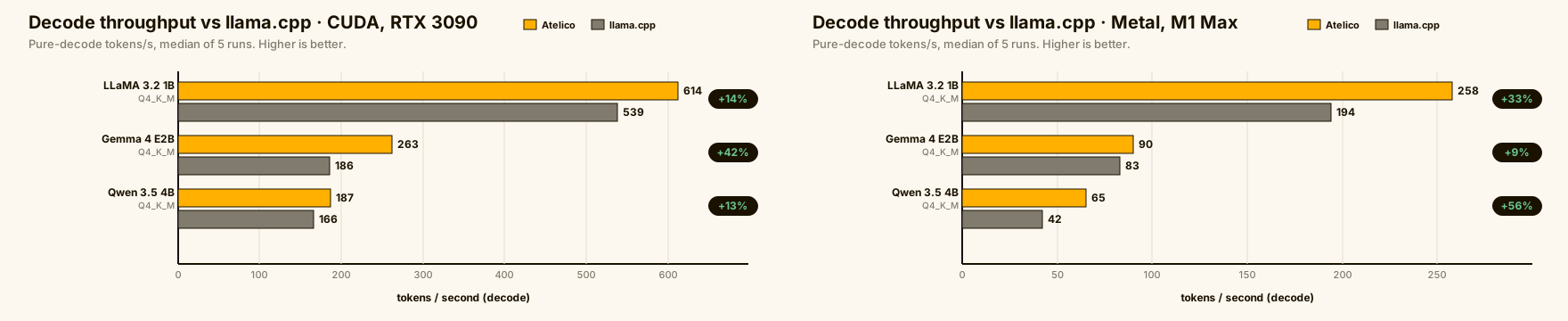
Pure-decode, median of 5 runs. Atelico leads llama.cpp on every model in our matrix on both CUDA and Apple Silicon.
Multi-turn dialogue: prefix-cache speed-up
On a ~1,000-token persona prompt the engine replays the cached KV state from the previous turn instead of re-prefilling, dropping time-to-first-token from 347 ms to 83 ms on M1 Max.
Tiny on disk, tiny in RAM
Smallest model footprint (Bonsai 1.7B 1-bit MLX), up to ~1.15 GB at the top of the range. Mid-size 3B Q4 models fit in ~2 GB. Small enough to ship inside the game.
Everything you need.
Generate
- • LLM Chat & Streaming
- • Fast Image Generation
- • Text-to-Speech, Speech-to-Text & Lip-Sync
- • Hot-Swappable Adapters
Understand
- • Semantic KV Store
- • Prefix Cache
- • Embeddings & Vector Search
- • Multimodal Retrieval
- • Text, Image, Audio Classifiers
Control
- • Character Behavior System
- • Structured JSON Output
- • Guardrails & Content Safety
- • Creative Control
Run
- • GPU Sharing (CGS)
- • Native Game-Engine Integration
- • Unified SDK
- • OpenAI-Compatible API
- • Multi-Backend Routing
Coming Soon
2D Animation
Frame interpolation for sprite animation from keyframes.
Image Editing
Instruction-based editing (img2img). No new model weights needed.
Supported models.
Every modality, on-device, on the same engine. Load straight from HuggingFace; new models are added as soon as they come out.
LLaMA 3.x · Qwen 3 / 3.5 · Gemma 4 (incl. MoE) · SmolLM 3 · Nemotron-H · Nemotron-3 Elastic · Bonsai 1-bit
Atelico IG
Whisper for STT · Kokoro 82M and Atelico TTS for TTS · Audio2Face for ARKit-52 lip-sync
Already shipping with Atelico.
Bobium Brawlers
Procedurally generated character art and in-game chat, all running on the player's device.
GARP
A life-simulation playground built on the Atelico behavior engine. Hundreds of agents, emergent dialogue, no scripted beats.
Be among the first studios to ship with Atelico.
Stay updated on our progress and grab one of the limited spots for early SDK access, priority support, and roadmap influence.
Built by AI and gaming industry veterans from Uber, Meta, SEGA, Creative Assembly, Stanford, and MIT.